
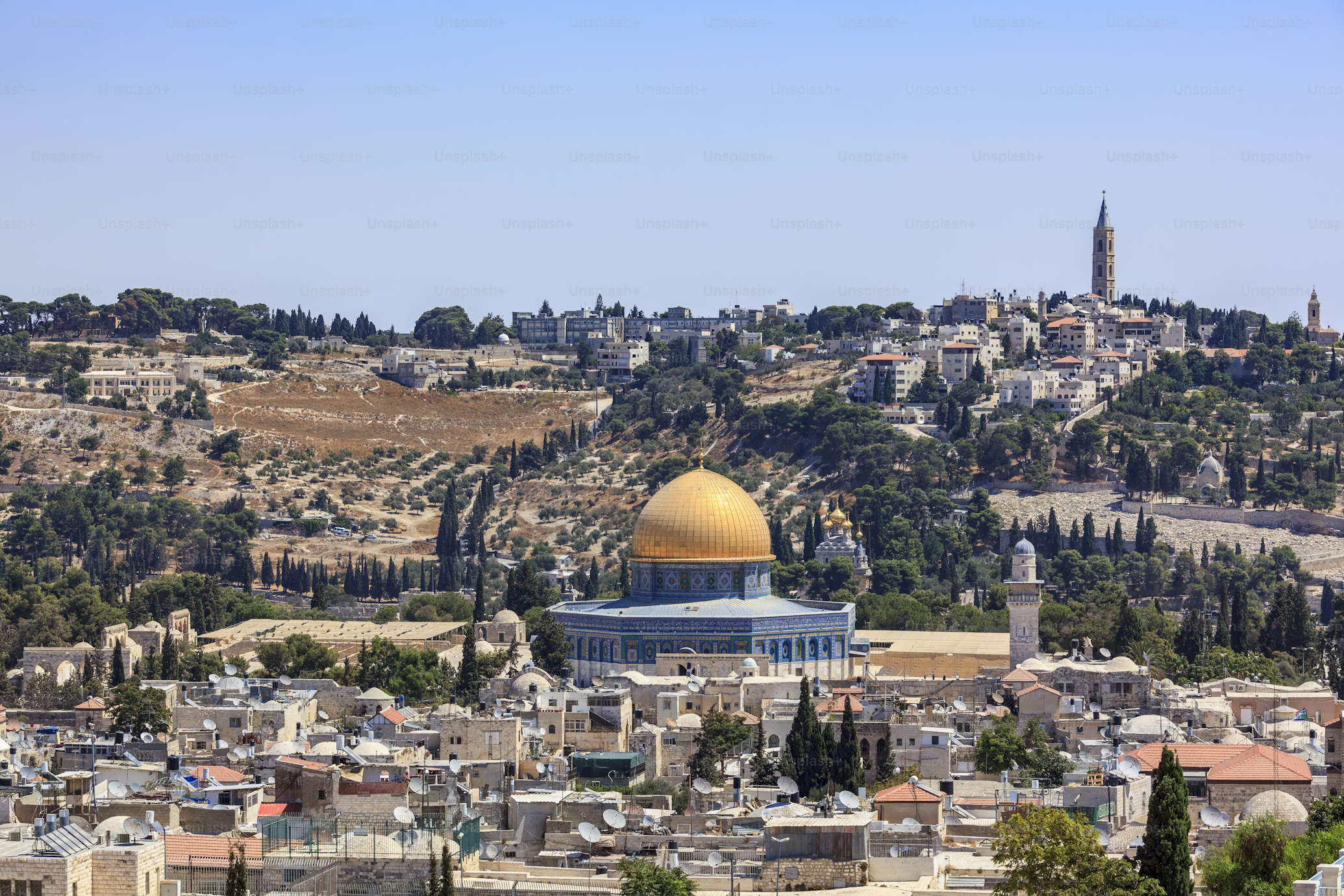
Sometimes we speak about Masjid Al-Aqsa as if it is only a place of politics, history or emotion. And of course, it is tied to all of those things. But before anything else, Masjid Al-Aqsa is a masjid. It is a place of salah, sujud, Qur’an, dhikr, learning and longing.
That is why travelling there is not just a normal trip. It is not just a city break to Jerusalem. It is not even just Islamic sightseeing. For a Muslim, travelling to Masjid Al-Aqsa is connected to Qur’an, hadith, the practice of the Sahabah, and centuries of Muslim scholarship.
It is one of those journeys where the road itself has meaning.
A journey mentioned in the Qur’an
When Allah speaks about the Night Journey of the Prophet ﷺ, He does not only mention Makkah. He mentions Masjid Al-Aqsa.
Allah says:
“Glory be to the One who took His servant by night from Al-Masjid Al-Haram to Al-Masjid Al-Aqsa, whose surroundings We have blessed, so that We may show him some of Our signs.”
Qur’an, Surah Al-Isra, 17:1
Just pause on that for a moment.
Allah could have described this journey in many different ways. But He chose to mention Masjid Al-Aqsa by name. He connected it to the Prophet ﷺ. He connected it to a miraculous journey. He described its surroundings as blessed. And He made this verse something Muslims would recite until the end of time.
That means when you travel to Masjid Al-Aqsa, you are not travelling to a place that became important later. You are travelling to a place Allah Himself mentioned in the Qur’an.
And notice the wording. Allah does not only say that Masjid Al-Aqsa is blessed. He says, “whose surroundings We have blessed.” The blessing is not presented as something narrow or isolated. It spreads into the land around it. This is why scholars often spoke about Bayt Al-Maqdis and the wider blessed land with such love. The masjid is the heart, but the land around it carries memory, prophecy and barakah.
So when you go there, you are walking into a Qur’anic landscape. You are standing in a place that the Qur’an made part of the Muslim imagination.
The Prophet ﷺ specifically encouraged travelling there
One of the clearest hadiths about travelling to Masjid Al-Aqsa is the famous narration of Abu Hurayrah رضي الله عنه, where the Prophet ﷺ said that a journey should not be undertaken to any mosque except three: Al-Masjid Al-Haram, the Mosque of the Messenger ﷺ, and Masjid Al-Aqsa.
This hadith is found in Sahih al-Bukhari and Sahih Muslim.
This is important because the hadith is not only speaking about the virtue of the place. It is speaking about travel. In the Arabic, the wording refers to setting out on a journey, which in our language today is like saying: do not pack your bags and travel with the special intention of praying in a mosque, except for these three mosques.
There are beautiful mosques all over the world. Historic mosques, grand mosques, local mosques and beloved mosques. But only three mosques have this particular Prophetic encouragement attached to them.
Masjid Al-Haram. Masjid Al-Nabawi. Masjid Al-Aqsa.
So when someone asks, “Why should I travel to Masjid Al-Aqsa?” one answer is very simple: because the Prophet ﷺ singled it out.
Not because of nostalgia. Not because of culture. Not because of tourism. Because the Messenger of Allah ﷺ mentioned it alongside the two holiest masajid in Islam.
This is why many scholars speak of Masjid Al-Aqsa as the third holiest place in Islam. The exact phrase “third holiest” is a later way of expressing it, but the meaning comes from the hadith itself: it is one of the three mosques for which a journey is specifically made for prayer and worship.
It was the first qiblah
Before Muslims faced the Ka‘bah in prayer, they faced Bayt Al-Maqdis.
In Sahih al-Bukhari, Al-Bara’ ibn ‘Azib رضي الله عنه narrates that the Prophet ﷺ prayed towards Bayt Al-Maqdis for sixteen or seventeen months after arriving in Madinah, before the qiblah was changed towards the Ka‘bah.
Then Allah revealed:
“Indeed, We see you turning your face towards heaven. Now We will surely turn you to a qiblah that will please you. So turn your face towards Al-Masjid Al-Haram.”
Qur’an, Surah Al-Baqarah, 2:144
But here is something many people miss.
The sixteen or seventeen months mentioned in the hadith refers specifically to the period after the Hijrah in Madinah. Classical tafsir works also mention that while the Prophet ﷺ was in Makkah, he prayed facing Bayt Al-Maqdis while positioning himself so that the Ka‘bah was also in front of him. In Makkah, he could face both. In Madinah, that was no longer geographically possible, so he continued facing Bayt Al-Maqdis for another sixteen or seventeen months until the qiblah was changed.
So when we say Masjid Al-Aqsa was the first qiblah, we should not reduce it to just sixteen or seventeen months. According to this understanding, the Prophet ﷺ and the earliest Muslims were connected to Bayt Al-Maqdis as a direction of prayer throughout the Makkan period, and then for another sixteen or seventeen months in Madinah. That is roughly thirteen years in Makkah, plus around a year and a half in Madinah. In total, about fourteen and a half years.
That is a long time.
For more than a decade, the earliest prayers, sujud, tears, fears and hopes of this Ummah were connected to Bayt Al-Maqdis as a direction of worship.
And here is the point: when the qiblah changed, Masjid Al-Aqsa did not lose its virtue.
Allah turned the direction of prayer to Makkah, but the Prophet ﷺ still taught us to travel to Masjid Al-Aqsa. It remained one of the three mosques. It remained connected to the Night Journey. It remained part of the sacred geography of Islam.
So visiting Masjid Al-Aqsa is not about looking backwards with old sentiment. It is about honouring a living part of our religion.
It is the second masjid established on earth
There is another hadith that gives Masjid Al-Aqsa an even deeper meaning.
Abu Dharr رضي الله عنه asked the Prophet ﷺ which mosque was first built on earth. The Prophet ﷺ said: Al-Masjid Al-Haram. Abu Dharr then asked which came next. The Prophet ﷺ said: Masjid Al-Aqsa. Abu Dharr asked how long was between them, and the Prophet ﷺ said: forty years.
This hadith is in Sahih al-Bukhari and Sahih Muslim.
This does not mean the exact buildings we see today were standing from the beginning of human history. Buildings are built, destroyed, repaired, expanded and restored. Masjid Al-Aqsa, like Masjid Al-Haram, has passed through many historical stages.
The deeper meaning is that the sacred place itself is ancient. Its foundation as a place of worship goes back to the earliest story of humanity’s worship of Allah.
This is one of the things that makes Masjid Al-Aqsa so powerful. It is not just an Umayyad building. It is not just a medieval landmark. It is not just a place from the time of Salahuddin. It is connected to the oldest sacred geography on earth.
The hadith places Masjid Al-Aqsa immediately after Al-Masjid Al-Haram in sacred time.
That is not a small virtue.
The Sahabah understood its importance
The Sahabah did not treat Masjid Al-Aqsa as a distant or irrelevant place.
When Jerusalem came under Muslim rule during the caliphate of ‘Umar ibn Al-Khattab رضي الله عنه, the reports about his arrival are full of meaning. Historical details differ between sources, as is normal with early history, but the broad memory preserved in Muslim tradition is that ‘Umar رضي الله عنه personally came to Jerusalem, received the city, and took care to restore the area of Masjid Al-Aqsa as a place of worship.
Later Muslim historians, including Mujir al-Din al-‘Ulaymi, associated the early Muslim prayer space at Masjid Al-Aqsa with ‘Umar رضي الله عنه. Academic historians also discuss how the early Muslims established worship at the southern end of the sacred platform after the conquest of Jerusalem.
Why does this matter?
Because ‘Umar رضي الله عنه was not just a political leader. He was from the closest generation to the Prophet ﷺ. His connection to Jerusalem shows that Masjid Al-Aqsa was not treated as a side issue. It was treated as an amanah.
And there is something very moving about that. The Prophet ﷺ had made the journey to Masjid Al-Aqsa during Al-Isra. The Muslims had prayed towards Bayt Al-Maqdis. Then, in the time of the Sahabah, the place itself returned to Muslim worship.
It is as if the story moves from revelation, to prayer, to travel, to responsibility.
Even supporting its light was considered meaningful
There is a beautiful report involving Maymunah رضي الله عنها, who asked the Prophet ﷺ about Bayt Al-Maqdis. In the narration found in Sunan Abi Dawud, the Prophet ﷺ told her to go and pray there. When difficulty in reaching it was mentioned, he advised sending oil for its lamps.
Scholars have discussed the chains and wording of these narrations, and some versions are stronger than others. So it is important not to build exaggerated claims on every wording. But the meaning preserved in the hadith literature is still remarkable.
The Prophet ﷺ directed people towards praying there. And if they could not physically go, they were still encouraged to support it.
That is a lesson on its own.
Not everyone can travel. Some people do not have the money. Some do not have the health. Some have family responsibilities. Some may be prevented by circumstances. But the heart should still be attached. If you cannot go, support. If you cannot support, speak about it. If you cannot speak, make dua. If you cannot stand there physically, keep it alive in your home, your teaching, your children and your heart.
Masjid Al-Aqsa is not only loved by those who have visited. It is loved by those who intend to visit, those who help others visit, and those who keep its memory alive.
Muslim scholars wrote entire books on its virtues
One thing many people do not realise is that the virtues of Masjid Al-Aqsa were not only mentioned in a few isolated sermons. Muslim scholars developed an entire genre of writing around the merits of Jerusalem and Bayt Al-Maqdis.
This genre is known as Fada’il Bayt Al-Maqdis, meaning the virtues or merits of Bayt Al-Maqdis.
Among the early works were writings attributed to scholars such as Al-Walid ibn Hammad al-Ramli, Abu Bakr al-Wasiti, and Ibn al-Murajja al-Maqdisi. Later scholars, historians and compilers also wrote about Jerusalem, including Mujir al-Din al-‘Ulaymi in Al-Uns al-Jalil and Jalal al-Din al-Suyuti in Ithaf al-Akhissa bi Fada’il al-Masjid al-Aqsa.
This matters because it shows that Muslim concern for Masjid Al-Aqsa is not a modern reaction. It is not something invented recently. It is rooted in Qur’an, hadith, early Muslim practice and classical Islamic scholarship.
Scholars recorded its virtues. Travellers described it. Geographers mapped it. Worshippers visited it. Rulers restored it. Generations of Muslims wrote about it with awe.
Travelling there keeps a Sunnah alive
One of the reasons I feel strongly about travelling to Masjid Al-Aqsa is because it revives something many Muslims have forgotten.
We all know about travelling for Umrah. We all know about travelling to Madinah. And rightly so. These journeys are among the greatest blessings of a Muslim’s life.
But the Prophet ﷺ mentioned three mosques, not two.
Masjid Al-Aqsa should not be absent from our travel ambitions. It should not feel strange for Muslims to say, “I want to go to Al-Aqsa.” It should feel normal. It should feel natural. It should feel like part of our religious imagination.
Of course, not everyone can go immediately. But we should at least restore the intention. We should teach our children that Masjid Al-Aqsa is not just a place they see in the news. It is one of our sacred mosques. It is the first qiblah. It is the place of Al-Isra. It is the second masjid established on earth. It is one of the three mosques the Prophet ﷺ taught us to travel to for prayer.
When you visit, you are not just taking a trip. You are helping restore a forgotten Sunnah in the hearts of people.
Visiting changes the way you understand the Ummah
There is something that happens when you stand inside Masjid Al-Aqsa.
You realise Islam is not just a religion of texts, although our texts are sacred. It is also a religion of places, memory and continuity. Makkah teaches you about tawhid and surrender. Madinah teaches you about love, Sunnah and community. Masjid Al-Aqsa teaches you about patience, inheritance, responsibility and the long story of the Prophets.
When you walk through the gates, you are not entering a museum. You are entering a living masjid.
People are praying. Children are running. Circles of knowledge are taking place. Qur’an is being recited. Elders are sitting quietly. Visitors are arriving with tears in their eyes because they never thought they would be able to come.
And that is when the hadith becomes real.
You remember that the Prophet ﷺ did not mention Masjid Al-Aqsa as an abstract idea. He mentioned it as a place to travel to, a place to pray in, a place to keep alive.
It is not only about what you see
Some people think the main reason to visit Masjid Al-Aqsa is to see the Dome of the Rock, Musalla Qibli, the gates, the old stones, the arches and the views of Jerusalem.
And yes, all of that is beautiful.
But the real reason to go is not only what you see. It is what the place does to you.
It reminds you that you belong to a story much bigger than yourself. It reminds you that the Prophets were real. Revelation was real. The sacrifices of the Sahabah were real. The love of the scholars was real. The tears of generations were real.
You start to understand why Muslims kept writing about this place for over a thousand years. You understand why travellers crossed deserts and seas to reach it. You understand why scholars preserved its virtues. You understand why the Prophet ﷺ included it among the three.
And you realise that sometimes love for a sacred place only becomes complete when you finally answer its call.
So why should you travel to Masjid Al-Aqsa?
Travel because Allah mentioned it in the Qur’an.
Travel because the Prophet ﷺ travelled there on the Night Journey.
Travel because he told this Ummah that it is one of the three mosques worthy of a journey.
Travel because it was the first qiblah.
Travel because it is the second masjid established on earth.
Travel because the Sahabah honoured it.
Travel because scholars preserved its virtues.
May Allah allow us to visit Masjid Al-Aqsa with sincerity, pray there with humility, understand its sacredness properly, and return as people who carry its love with knowledge, adab and responsibility.
Share:
Masjid Al-Aqsa Travel Tips: What to Know Before You Go
Is It Safe to Travel to Masjid Al-Aqsa?