
The words we use for Masjid Al-Aqsa are not a minor issue. Terminology shapes how people imagine a place, and that imagination influences attachment, worship and responsibility.
When Masjid Al-Aqsa is repeatedly presented as one building, everything outside that building begins to look secondary. The Dome of the Rock appears separate, the open spaces are treated as empty land, and the internal prayer halls are described as independent mosques.
Correct terminology restores the correct picture.
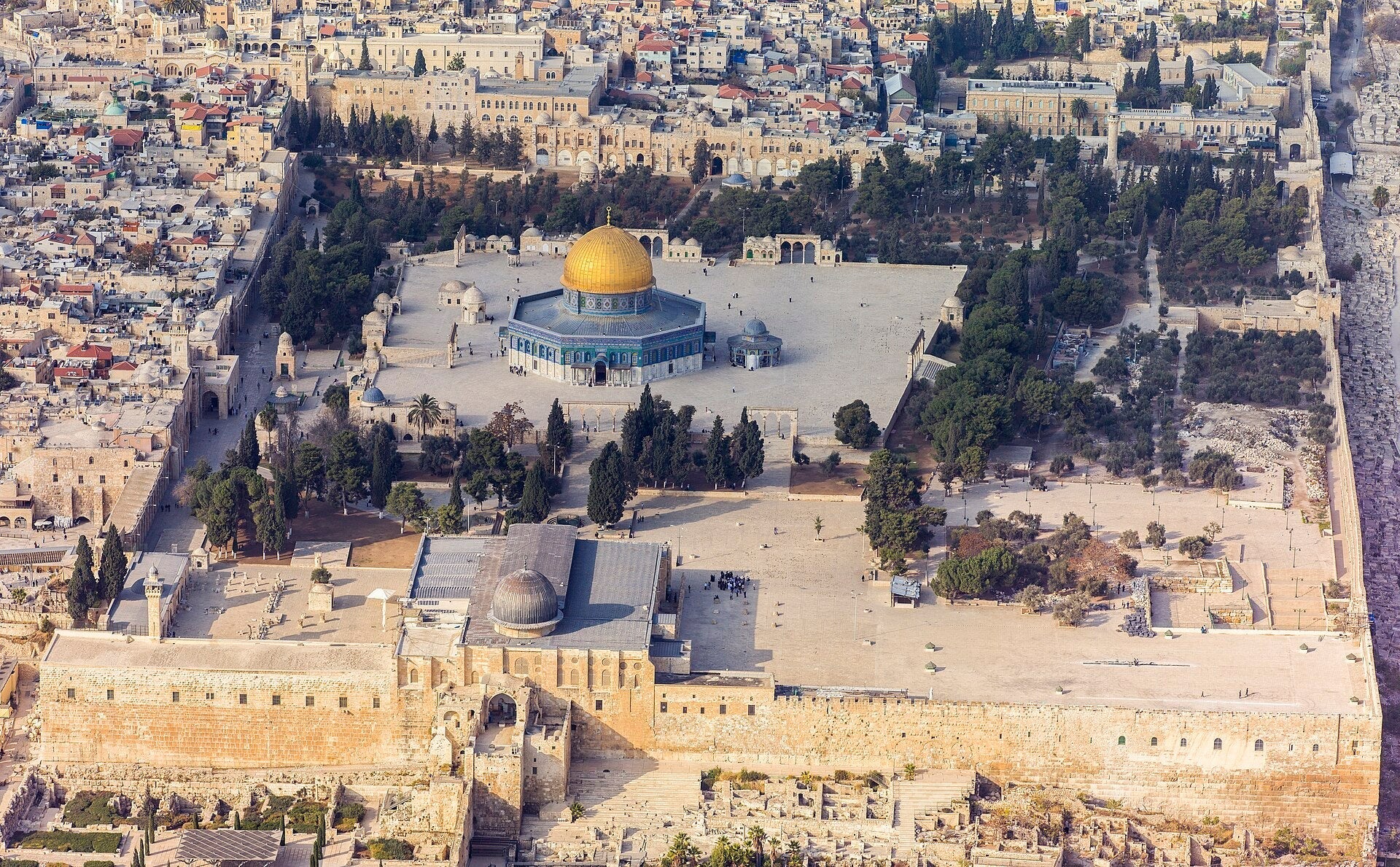
Masjid Al-Aqsa is the entire sacred masjid enclosed within its surrounding walls. It includes its prayer halls, domes, platforms, gates, arcades, schools, fountains, pathways and open spaces.
This is not a modern interpretation. It is the understanding expressed by major Muslim scholars throughout history.
Allah called it Masjid Al-Aqsa
Allah says:
﴿سُبْحَانَ الَّذِي أَسْرَىٰ بِعَبْدِهِ لَيْلًا مِنَ الْمَسْجِدِ الْحَرَامِ إِلَى الْمَسْجِدِ الْأَقْصَى الَّذِي بَارَكْنَا حَوْلَهُ﴾
“Glory be to the One Who took His servant by night from Al-Masjid Al-Haram to Al-Masjid Al-Aqsa, whose surroundings We have blessed.”
Surah Al-Isra, 17:1
The Qur’an does not simply call it “Al-Aqsa”. Allah calls it Al-Masjid Al-Aqsa.
The word Masjid is part of its revealed name, just as it is part of Al-Masjid Al-Haram in the same verse:
مِنَ الْمَسْجِدِ الْحَرَامِ إِلَى الْمَسْجِدِ الْأَقْصَى
“From Al-Masjid Al-Haram to Al-Masjid Al-Aqsa.”
We would not normally refer to Al-Masjid An-Nabawi merely as “Nabawi”, nor would we continually remove the word Masjid from Al-Masjid Al-Haram.
In the same way, Masjid should not be treated as an optional word when speaking about Masjid Al-Aqsa.
Using the complete Qur’anic name preserves both its sacred identity and its correct physical definition.
The entire area within the walls
One of the clearest classical statements comes from Shaykh Al-Islam Ibn Taymiyyah:
فَإِنَّ الْمَسْجِدَ الْأَقْصَى اسْمٌ لِجَمِيعِ الْمَسْجِدِ
“Masjid Al-Aqsa is the name of the entire masjid.”
He explained that some people had begun using the name Masjid Al-Aqsa specifically for the roofed prayer building at the southern end. He corrected this by stating that Masjid Al-Aqsa was the name of the whole masjid, not one internal structure.
Ibn Taymiyyah also wrote:
وَالْأَقْصَى اسْمٌ لِلْمَسْجِدِ كُلِّهِ
“Al-Aqsa is the name of the whole masjid.”
The Jerusalem historian Mujir Al-Din Al-Ulaymi gave an even more precise definition:
وَحَقِيقَةُ الْحَالِ أَنَّ الْأَقْصَى اسْمٌ لِجَمِيعِ الْمَسْجِدِ مِمَّا دَارَ عَلَيْهِ السُّورُ
“The reality is that Al-Aqsa is the name of the entire masjid enclosed by the wall.”
He explained that the southern prayer building, the Dome of the Rock, the arcades and the other structures were all located within Masjid Al-Aqsa.
The physical boundary is therefore clear. Everything enclosed by the walls belongs to Masjid Al-Aqsa.
The Musalla Qibli is not the whole masjid
The large silver domed prayer hall at the southern end should be called the Musalla Qibli.
It is called Qibli because it stands on the qiblah side of Masjid Al-Aqsa. It is one of the main roofed prayer spaces within the masjid, but it is not separately the whole of Masjid Al-Aqsa.
Calling the Musalla Qibli alone “Masjid Al-Aqsa” creates two misunderstandings.
First, it reduces the masjid from the entire enclosed sacred space to one building.
Second, it makes the remaining area look as though it is outside the actual masjid.
This is the very confusion Ibn Taymiyyah addressed centuries ago.
A photograph of the silver domed building should therefore be captioned:
“The Musalla Qibli within Masjid Al-Aqsa.”
This gives the building its proper honour without reducing the definition of the entire masjid.
The Dome of the Rock is inside Masjid Al-Aqsa
The Dome of the Rock is one of the most recognisable Islamic structures in the world. However, it is not a separate sacred site standing beside Masjid Al-Aqsa.
It is inside Masjid Al-Aqsa.
A person praying inside the Dome of the Rock is praying within Masjid Al-Aqsa. A person standing on the raised platform around it is still inside Masjid Al-Aqsa.
The Dome of the Rock should therefore be described as:
“The Dome of the Rock within Masjid Al-Aqsa.”
It is misleading to present visitors with a choice between “Masjid Al-Aqsa” and “the Dome of the Rock”, as though they are two separate destinations.
The same applies to the Dome of the Chain, the Dome of the Ascension, the Dome of Musa and the other domes and platforms.
They are all landmarks within Masjid Al-Aqsa.
One masjid with several musallas
Masjid Al-Aqsa contains several prayer halls and prayer spaces.
The Musalla Marwani is within Masjid Al-Aqsa.
The ancient lower prayer area beneath the Musalla Qibli is within Masjid Al-Aqsa.
The Musalla Al-Buraq is within Masjid Al-Aqsa.
The women’s prayer area is within Masjid Al-Aqsa.
These should not be presented as several independent mosques gathered inside a religious complex.
There is one Masjid Al-Aqsa, containing several musallas and many landmarks.
For this reason, using the word Musalla for the internal prayer halls is often clearer than calling each of them a separate masjid. It preserves the identity of Masjid Al-Aqsa as one complete sacred space.
Why “compound” and “complex” are misleading
English language reporting regularly refers to the “Al-Aqsa compound” or the “Al-Aqsa complex”.
These expressions may appear convenient, but they create the wrong mental image.
A compound is usually understood as an area containing several separate buildings. A complex is normally imagined as a group of structures gathered in one location.
Both words suggest that Masjid Al-Aqsa is one building inside a larger area.
The classical definition is the opposite. The buildings are within Masjid Al-Aqsa. The open land is within Masjid Al-Aqsa. The platforms, pathways, arcades and trees are within Masjid Al-Aqsa.
The masjid is not contained inside the compound. The area commonly called the compound is itself the masjid. The simplest and most accurate expression is therefore Masjid Al-Aqsa. Where explanation is required, one may say: “The entire area enclosed by the walls of Masjid Al-Aqsa.”
Why “courtyard” is also inadequate
The word courtyard creates a similar misunderstanding.
A courtyard is usually an open area attached to a building. When people describe the open spaces as “the courtyard of Masjid Al-Aqsa”, they may imagine that the Musalla Qibli is the actual mosque and everything outside it is merely surrounding land.
But the open spaces are not outside Masjid Al-Aqsa.
They are part of Masjid Al-Aqsa.
When a visitor enters through one of the gates in the enclosing walls, that person has entered the masjid. They do not need to reach the door of the Musalla Qibli before entering Masjid Al-Aqsa.
This also has a practical consequence.
The duʿā for entering a masjid should be read when entering through one of the gates of Masjid Al-Aqsa, not only when entering an internal prayer hall.
What about Al-Haram Al-Sharif?
The expression Al-Haram Al-Sharif, meaning the Noble Haram, has been used historically and remains common in political, academic and administrative language.
However, it is not the most precise Islamic terminology.
In Islamic law, the word haram carries specific rulings. Makkah and Madinah have recognised haram boundaries and particular rulings relating to hunting, vegetation and sacred territory.
Ibn Taymiyyah wrote concerning Masjid Al-Aqsa:
وَلَا يُسَمَّى هُوَ وَلَا غَيْرُهُ حَرَمًا، وَإِنَّمَا الْحَرَمُ بِمَكَّةَ وَالْمَدِينَةِ خَاصَّةً
“It and other places are not called a haram. The haram is specifically in Makkah and Madinah.”
This does not mean that everyone using the phrase Al-Haram Al-Sharif intends something incorrect. Many Muslims use it respectfully and lovingly. The issue is precision.
Masjid Al-Aqsa is the name chosen by Allah in the Qur’an. Al-Haram Al-Sharif is a later descriptive expression. For Islamic education, Masjid Al-Aqsa should remain the primary and preferred terminology.
Masjid Al-Aqsa, Al-Quds and Bayt Al-Maqdis
These names are connected, but they are not always identical in meaning.
Masjid Al-Aqsa refers to the masjid enclosed within its walls.
Al-Quds usually refers to the city of Jerusalem.
Bayt Al-Maqdis is used more flexibly in classical sources. Depending on the context, it may refer to the masjid, the holy city or the wider sacred location associated with Jerusalem.
When speaking specifically about the enclosed masjid, Masjid Al-Aqsa is the clearest term.
When speaking about Jerusalem as a city, Al-Quds or Bayt Al-Maqdis may be more appropriate.
Correct terminology helps us distinguish between the masjid, the city and the wider blessed land.
Images also teach terminology
Misunderstanding is not created only through words. Images teach definitions too.
If an article is titled “Masjid Al-Aqsa” but only shows the Musalla Qibli, people may assume the silver domed building is the whole masjid.
If every photograph shows only the Dome of the Rock, others may believe the golden domed structure alone is Masjid Al-Aqsa.
Both structures should continue to be shown, but they should be captioned correctly.
“The Musalla Qibli within Masjid Al-Aqsa.”
“The Dome of the Rock within Masjid Al-Aqsa.”
Aerial images should also be used regularly so people can see that the entire area within the walls forms Masjid Al-Aqsa.
Why terminology matters
This is not simply a debate about words.
If people believe Masjid Al-Aqsa is only the Musalla Qibli, events elsewhere within the walls may appear to be happening outside the masjid.
If the open areas are described as a compound or courtyard, people may fail to understand that those spaces are part of the masjid itself.
If the Dome of the Rock and Masjid Al-Aqsa are presented as separate sites, the unity of the masjid is broken in people’s minds.
Mujir Al-Din summarised the matter clearly:
وَالْمُرَادُ بِالْمَسْجِدِ الْأَقْصَى هُوَ جَمِيعُ مَا دَارَ عَلَيْهِ السُّورُ
“What is meant by Masjid Al-Aqsa is everything enclosed by the wall.”
Share:
Is It Safe to Travel to Masjid Al-Aqsa?
What Exactly Is Masjid Al-Aqsa?