
Imwas: The Stronghold on the Road to Masjid Al-Aqsa and the Plague That Changed Muslim History
Most people travelling between the coast and Jerusalem pass the Latrun area without realising what once stood there. Beneath the trees, picnic paths and signs of Canada Park lie the remains of Imwas, a Palestinian village whose location made it one of the most important gateways on the road to Al-Quds. Its story brings together two very different catastrophes, separated by more than thirteen centuries: the Plague of Imwas, which took the lives of some of the greatest Companions, and the forced displacement and destruction of the village in 1967.
Imwas was not a fortress in the simple sense of a castle surrounded by walls. Its strength came from its position. The village stood beside the Latrun heights, on the historic route linking Jaffa and the Mediterranean coast with Jerusalem. Whoever controlled this narrow approach could control, obstruct or defend one of the main roads leading towards the city. In that sense, Imwas formed part of a stronghold guarding the western road to Jerusalem and, beyond it, Masjid Al-Aqsa.
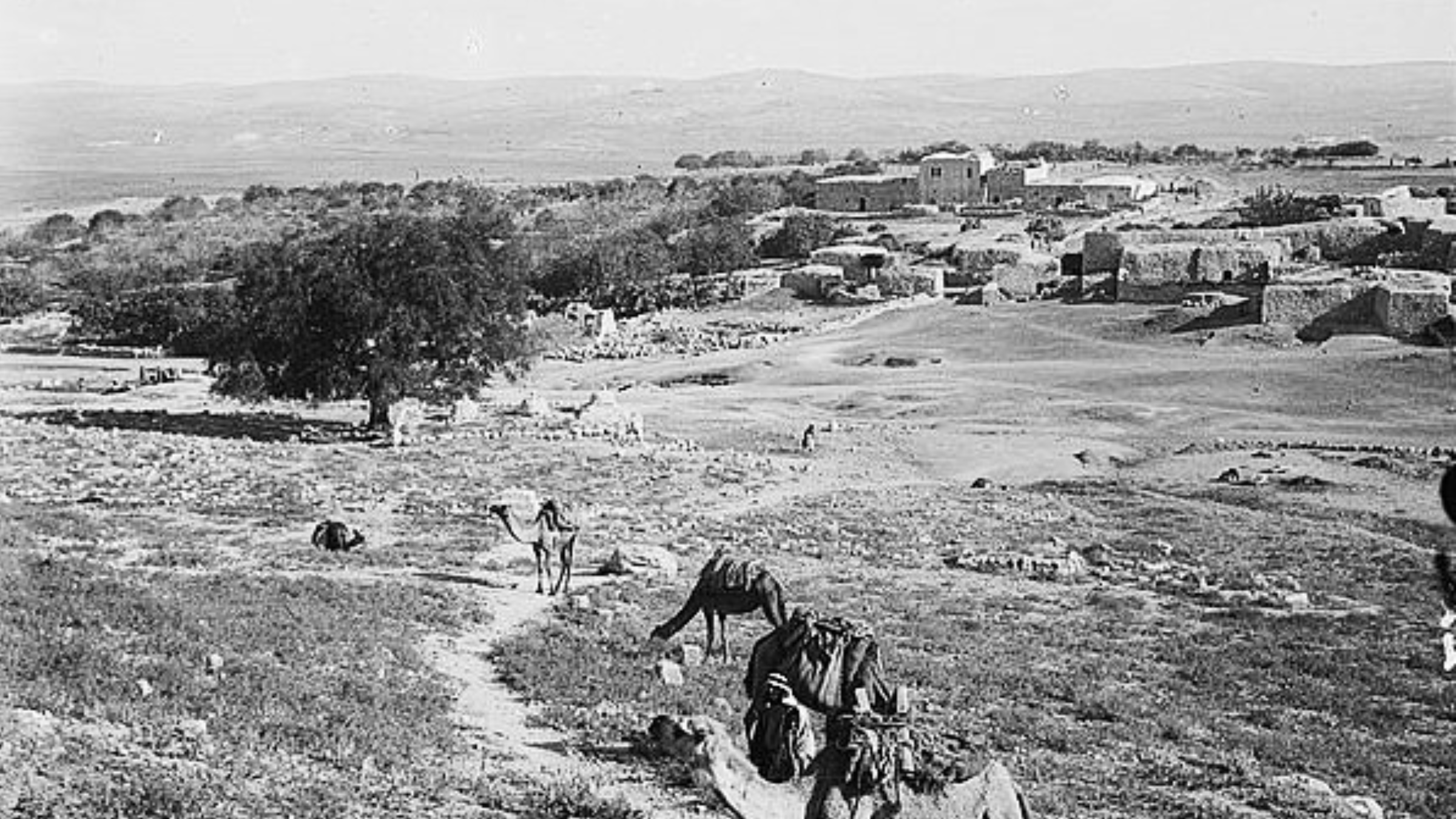
 Imwas on the Jaffa to Jerusalem road, photographed around 1900. Matson Collection, Library of Congress. Public domain.
A stronghold on the road to Jerusalem
The strategic value of the area became especially clear during the war of 1948. The Jordanian Arab Legions Fourth Battalion, commanded by Habis al-Majali, took defensive positions at Latrun, while villagers and local fighters helped defend the surrounding area. Israeli forces launched repeated attacks in an attempt to open the direct road to Jerusalem, but failed to capture the Latrun position. A bypass, later known as the Burma Road, had to be constructed around it.
This is why the defence of Imwas was much bigger than the defence of one village. Holding the area restricted movement along the direct route between the coastal plain and Jerusalem. The village and its neighbours remained under Jordanian control after the 1949 armistice and survived until June 1967. For nearly two decades, the line held.

A map showing Imwas, Yalu and Beit Nuba in relation to Canada Park and the former armistice lines. Map by Zero0000, CC BY 3.0.
The Plague of Imwas
Imwas had already occupied an important place in Muslim history long before the modern struggle over Palestine. Following the Muslim conquest of the region, it became a military camp and an administrative centre during the Rashidun period. In 18 AH, around 639 CE, a devastating epidemic began in the area and spread across Bilad al-Sham. It became known in the historical sources as Ta'un Amwas (the Plague of Imwas).
Later Muslim chroniclers commonly transmitted a death toll of around 25,000 across the wider region, although figures from medieval epidemics should always be treated as estimates. Among those who died were Abu 'Ubaydah ibn al-Jarrah, Mu'adh ibn Jabal and Yazid ibn Abi Sufyan, as well as many other Companions, soldiers and civilians. Abu 'Ubaydah and Mu'adh are closely linked to the memory of the plague, but their recognised burial places are in present-day Jordan, not in Imwas. Local tradition did preserve a maqam associated with Abu 'Ubaydah in the village, which may explain why some accounts describe Imwas as the site of his shrine.
Ibn Kathir, in Al-Bidayah wa al-Nihayah, records the painful exchanges between 'Umar ibn al-Khattab and Abu 'Ubaydah as the epidemic intensified. 'Umar attempted to call him away, but Abu 'Ubaydah understood that the Caliph was trying to save him and refused to abandon the Muslim army under his care. 'Umar then advised that the people be moved away from low, damp ground to higher and healthier land. Later reports describe 'Amr ibn al-As dispersing people into the hills until the outbreak subsided. These accounts show Muslim leaders combining reliance upon Allah with practical measures to reduce harm.
إِذَا سَمِعْتُمْ بِالطَّاعُونِ بِأَرْضٍ فَلَا تَقْدَمُوا عَلَيْهِ، وَإِذَا وَقَعَ بِأَرْضٍ وَأَنْتُمْ بِهَا فَلَا تَخْرُجُوا فِرَارًا مِنْهُ
“When you hear that plague has struck a land, do not enter it. If it occurs in a land while you are there, do not leave it in flight from it.”
Sahih al-Bukhari and Sahih Muslim
This hadith is sometimes presented as proof that Muslims invented quarantine. That claim goes further than the historical evidence allows. Forms of separating the sick existed before Islam, while the organised forty-day quarantine system from which the modern word developed appeared in Mediterranean ports centuries later. What can safely be said is that the Prophet ﷺ gave Muslims a remarkably clear epidemic rule in the seventh century: do not knowingly enter an afflicted region, and do not flee from it in a way that may carry the disease elsewhere.
The rule was applied during the Plague of Imwas. When 'Umar reached Sargh on his journey towards Syria and learned that an epidemic had broken out, he consulted the Companions and decided to return with the people rather than expose them to it. 'Abu 'Ubaydah asked whether they were fleeing from the decree of Allah. 'Umar replied with words that capture the Islamic balance between faith and precaution: We flee from the decree of Allah to the decree of Allah. Taking precautions was not a rejection of tawakkul. It was part of it.
The morning Imwas was emptied
That earlier tragedy did not bring the story of Imwas to an end. The village continued to be inhabited for centuries. A Jordanian census recorded 1,955 residents in 1961, and the population had grown further by the time war returned to the area. On the morning of 6 June 1967, Israeli forces entered Imwas. Residents who had fled the shelling or taken shelter in the nearby monastery were gathered and ordered to leave eastwards towards Ramallah. They were forbidden from returning to their homes.
Haydar Abu Ghowsh, who was displaced from Imwas, remembered the orders given to the villagers: You are not allowed to go to your homes. Keep heading towards Ramallah.He recalled the first tank he saw as he left the monastery, surrounded by soldiers, and said that the sight and the order to leave created a wound that could not be healed. His words turn a military event into what it really was for those who lived through it: the sudden loss of a home, a village and an entire way of life.
 Imwas in June 1967, before the village was completely demolished. Photograph by Yosef Ohman, CC BY-SA 3.0.
Imwas was then demolished, together with the neighbouring villages of Yalu and Beit Nuba. Around 10,000 people from the three villages were expelled during the war. Many of the displaced families eventually settled in Jordan, while others rebuilt their lives in Ramallah, al-Bireh, Beitunia, Jerusalem and elsewhere. They were physically removed from the village, but the village remained present in family names, memories, photographs and stories passed down to children who had never been permitted to return.
Canada Park and the landscape of forgetting
In the 1970s, the Jewish National Fund used donations raised through its Canadian branch to establish Canada Park over land belonging to Imwas, Yalu and Beit Nuba. A United Nations report later listed the park as occupying 4,200 dunams of land from the destroyed villages, including approximately 1,500 dunams of orchards. Woodland, picnic areas and walking trails now dominate the landscape.
The trees did not erase every trace. Pieces of walls, broken concrete, exposed ironwork, old paths and parts of the cemeteries remain. Yet the park changes how visitors read the land. A person can enjoy the shade and scenery without ever being told that a living Palestinian community stood there only a generation ago. A community that once stood in the way to protect Masjid Al-Aqsa The ruins survive, but they are easy to miss unless someone knows where to look and what questions to ask.
 Remains of a demolished house in Imwas among the vegetation of the park. Photograph by TsipiMagen, CC BY-SA 3.0.
Imwas therefore carries three histories at once. It was a strategic position on the western road to Jerusalem, a place whose defence helped hold the route in 1948. It gave its name to one of the most devastating epidemics in early Muslim history, during which the Companions showed that faith does not mean ignoring danger. It was also a village whose residents were expelled and whose homes were demolished in 1967, before a park was planted across much of its land.
For anyone travelling this road towards Masjid Al-Aqsa, Imwas is worth remembering. The stronghold eventually fell, but its story survived. The plague teaches responsibility, patience and the taking of sensible precautions. The displacement teaches that a place can be covered, renamed and transformed, yet still remain alive in the memory of its people. The trees are part of the landscape today, but they are not the beginning of its story.
Sources and further reading
Sahih al-Bukhari, Book of Medicine; Ibn Hajar al-Asqalani, Fath al-Bari; Ibn Kathir, Al-Bidayah wa al-Nihayah, account of the Plague of Imwas; Jordan Armed Forces,

Share:
What Exactly Is Masjid Al-Aqsa?